CSotD: Achieving His Own-Goals
Skip to comments
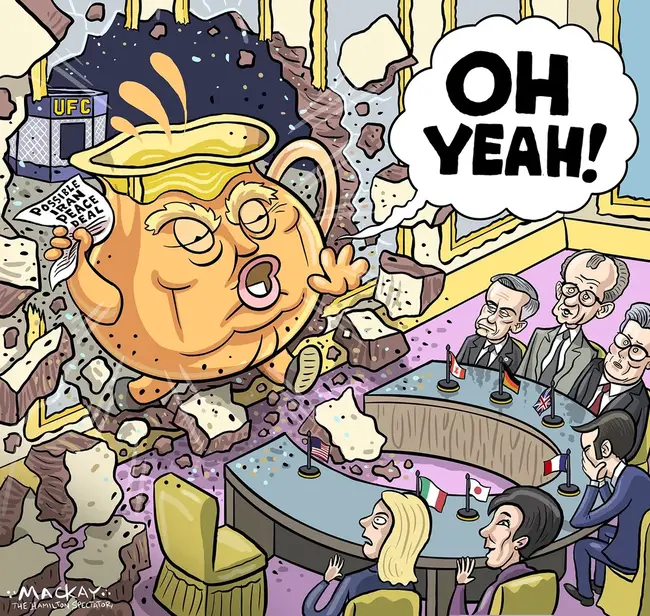
This being a where-to-begin moment, we might as well start with Trump arriving late at the G7 Summit and declaring “I’m the Boss!” to a response of laughter that was either appreciative or mocking, depending on which reports you read. Obviously, MacKay was among those who were not amused.
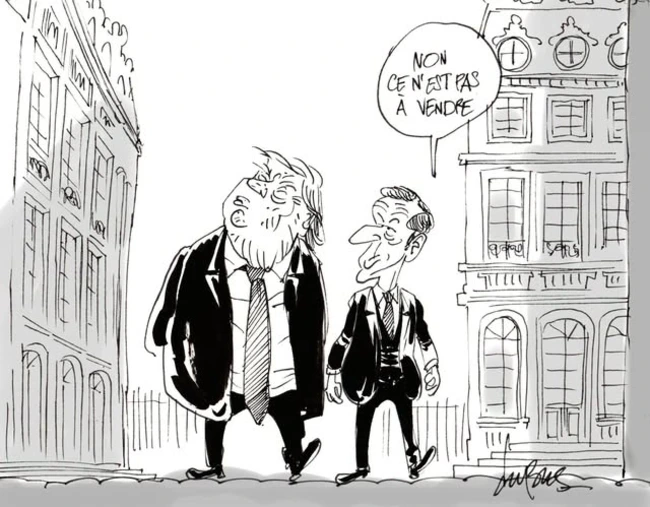
Nor was du Bus impressed. French President and G7 host Emmanuel Macron took Trump to dinner at Versailles, making the point that it was not a gala feast, though probably not having to say, as he does in this cartoon, “No, it’s not for sale.”
However, the G7 leaders — Canada, France, Germany, Italy, Japan, the United Kingdom, and the United States, plus the EU — signed a statement praising Trump for the Memo of Understanding that is to start talks aimed at ending the war in Iran. The group’s statement also pledged tough sanctions on Russia.
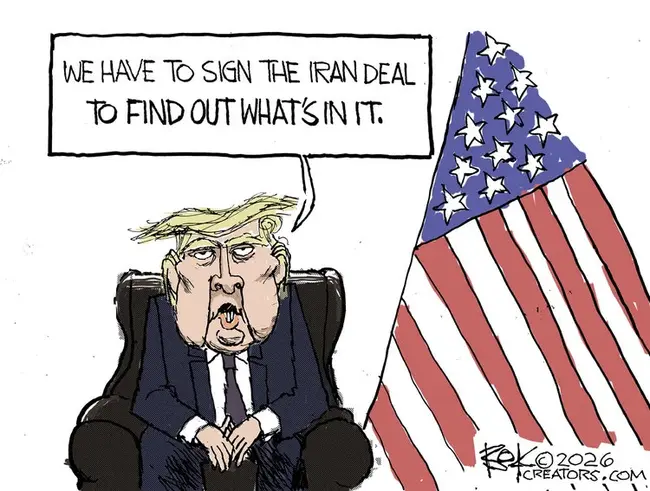
Other observers have been less supportive of the MOU. Before the text was released, Bok criticized the administration’s vagueness by recalling Nancy Pelosi’s much-derided comment on the Affordable Care Act that people wouldn’t realize its value until it was in effect.
He’s not wrong that Trump had announced the Memo in largely undisclosed details and made it seem more like an actual treaty than an agreement to talk.
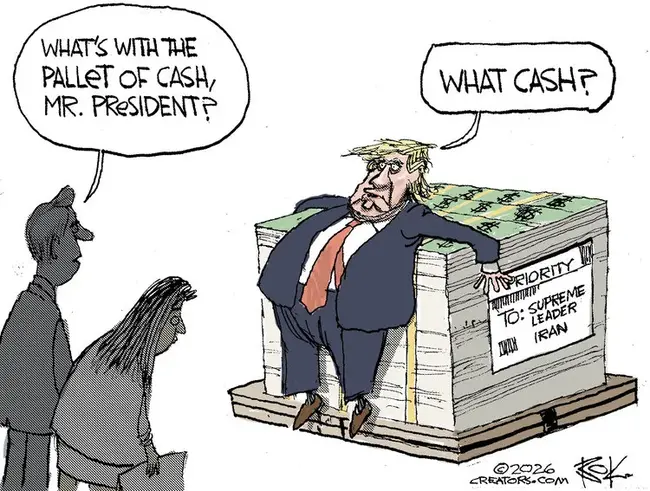
The text of the memo has now been released, and Bok remains skeptical. He is not the only one on the right who is unhappy with the details, which include not only release of frozen Iranian funds but an additional $300 billion in reparations.
Bok cites the “pallets of cash” that were part of Obama’s earlier agreement with Iran, and came under heavy criticism from the right wing despite their being Iran’s own money that had been frozen.
The $300 billion is in addition to a second release of frozen Iranian funds, but it is expected to come from other Persian Gulf states as well as the US, though there will likely be adjustments as the memo becomes an actual treaty.
The old saying “there’s many a slip twixt cup and lip,” applies to much of the agreement, as this analysis of the text indicates.
Juxtaposition of the Day
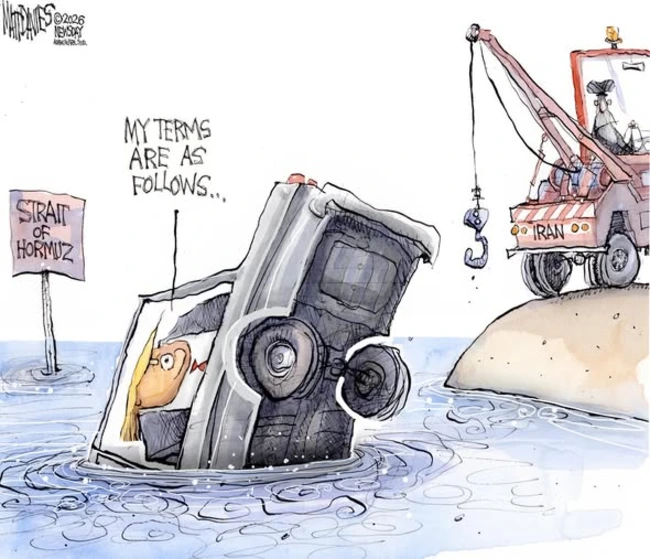
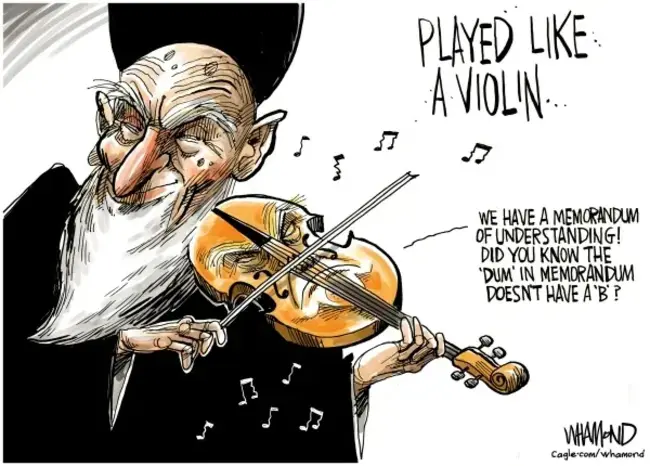
An interesting pair of variations on the same tune: Davies suggests that Trump had gotten himself into an unwinnable disaster of a situation, and is counting on Iran’s cooperation to help get him out.
It’s not hard to defend this analysis, given that Iran had little need to approve an end to hostilities, since they held the rest of the world hostage to their closure of the strait and they aren’t vulnerable to pressure from their own people.
They were therefore, Whamond says, able to hold out for an agreement that gave them everything they wanted and a more favorable outcome than they’d had under the multi-nation Joint Comprehensive Plan of Action (JCPOA) they signed in 2015.
Juxtaposition of the Day #2
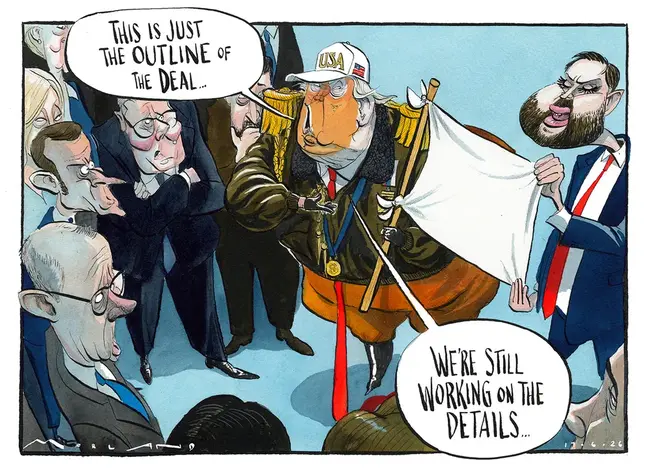
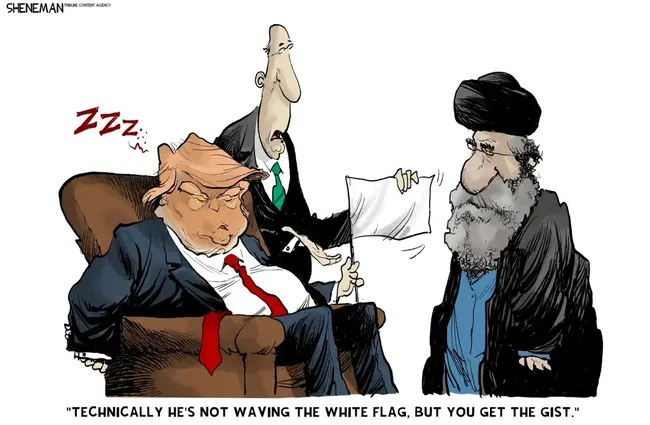
Morland and Sheneman offer two of several “white flag” cartoons that have greeted the MOU, each styling it a surrender rather than a comprehensive two-party agreement, and suggesting that Trump suffered an embarrassing and costly defeat.
Morland posits the matter as assuring the G7 that it really does spell the end of hostilities but not explaining either the details or how the US expects to bring Iran not just to the bargaining table but to a final agreement.
And Sheneman suggests that Trump wants to come across to Iran as a hard bargainer whom they ought to listen to and defer to, despite his inadequate grasp of realpolitik bargaining and the obvious appearance of a desperate search for a way out of the bind.
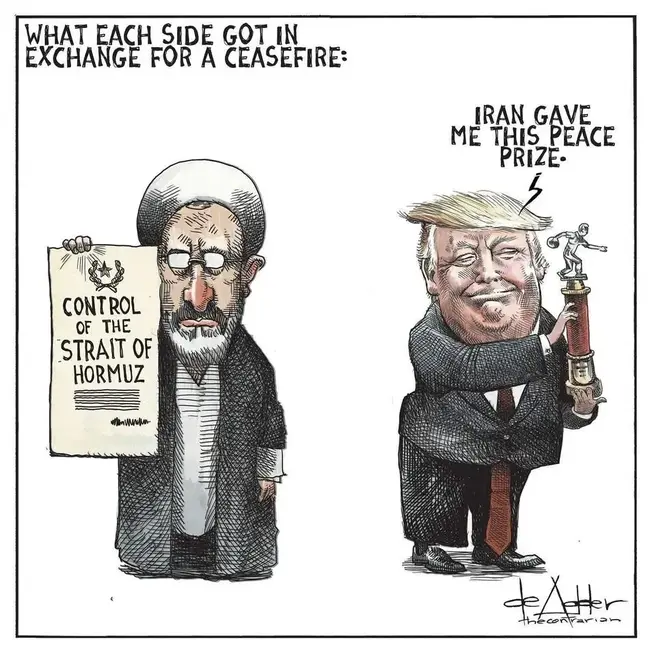
It all raises, de Adder says, the specter of Iran walking away with more power that they had before the war began, while Trump will have to be content with taking credit for having stopped a war he started himself, and having done so without gaining anything except whatever empty bravado he can claim.
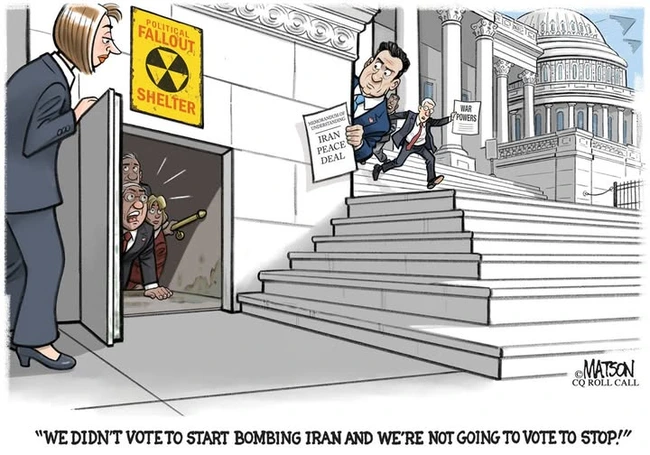
Meanwhile, Matson notes that, having blundered into the war without Congressional approval or even serious consultation with Congress, Trump’s efforts to get approval for a treaty over a war that American voters have largely condemned is going to be tricky.
Trump may have wanted to bail out of the confrontation before midterms, but any legislator in a tight race will have to tread very carefully when called upon to accept or reject the deal.
Juxtaposition of the Day #2
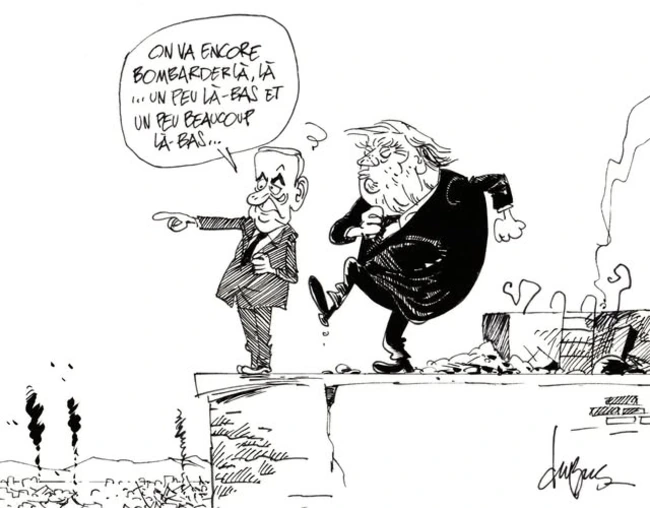
We’ll bomb again there, there … a little there and a little more over there.
A major complication is that, while an end to fighting in Lebanon is specified in the first paragraph of the MOU, the word “Israel” appears nowhere in the agreement, nor is Israel a signatory to the memo. And yet that end of fighting is an absolute rock-hard Iranian demand.
Trump may, as du Bus has it, be tempted to kick Netanyahu off a cliff, but the fact is that Israel flat out refuses to withdraw from Lebanon, or, for that matter, from Gaza or Syria. There’s little chance of turning the memo into a treaty without that happening, and little chance of it happening, either.
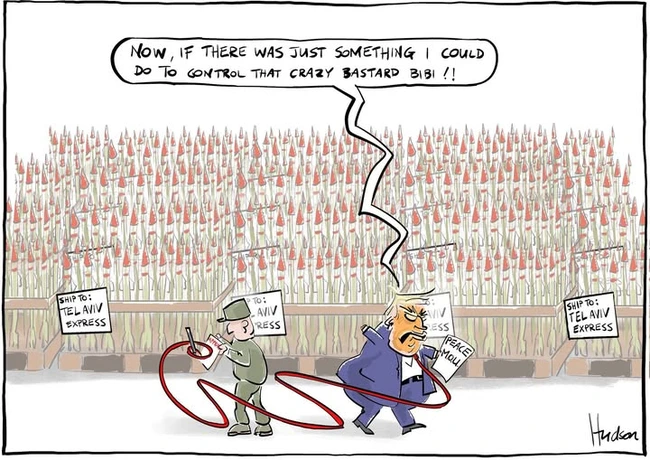
Though Hudson suggests that the Americans have only themselves to blame, given their continuing military aid to Israel, such that Trump may want Netanyahu to halt his aggression but is, at the same time, signing the orders approving arms shipments.
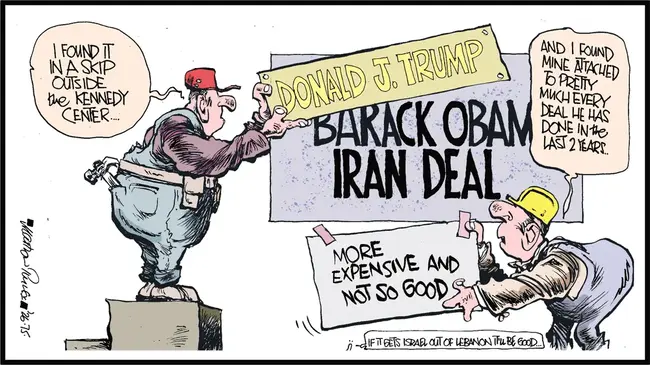
Turner repeats the popular view, that Obama had earlier come up with a treaty that worked, and that the best Trump might hope for is a return to that, but that, in fact, the Obama treaty offered more to the West and whatever Trump comes up with will be far more favorable to Iran.
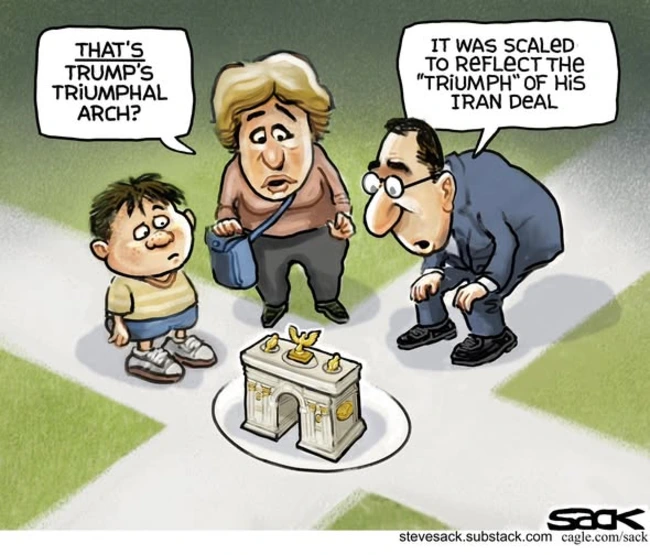
And Sack points out what may be the most painful aspect of the outcome for Donald Trump: It will cast a serious shadow on the glorious historical legacy and reputation that he has spent to much time and money attempting to promote for himself, and will place his presidency, in history and in public memory, alongside his casinos, his university, his steaks and his airline.
Mike Peterson has posted his "Comic Strip of the Day" column every day since 2010. His opinions are his own, but we welcome comments either agreeing or in opposition.
Comments 12