Pat Oliphant – RIP
Skip to comments
Editorial cartoonist Pat Oliphant has passed away.
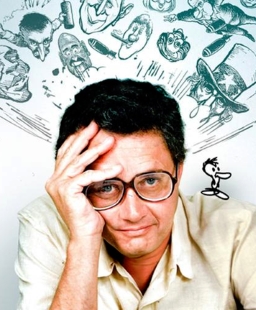
Patrick Bruce (Pat) Oliphant
July 24, 1935 – July 13, 2026
Cormac Dodd at The Sante Fe New Mexican is reporting the death of Pat Oliphant.
Pat Oliphant, a Pulitzer Prize-winning political cartoonist whose cutting sketches critiqued power and corruption in U.S. politics over a lengthy career that made him one of the most recognizable and lauded artists in the newspaper business, died Monday morning.
He was 90 years old.
His son, Grant Oliphant, said he died at his home in Santa Fe after suffering from a variety of age-related illnesses.
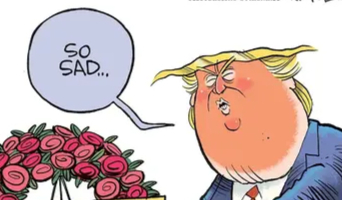
Pat Oliphant was a widely admired and highly influential newspaper cartoonist whose work lampooned American powerbrokers — chronicling their missteps with his own brand of grim fury — from President Richard Nixon to President Donald Trump. He was often described as the most syndicated editorial cartoonist in the country, and his daily political cartoons once appeared in more than 500 publications worldwide.

The New York Times in 1990 called Oliphant “the most influential editorial cartoonist” of his time
Last year The Daily Cartoonist joined in celebrating Pat’s 90th birthday.
Pat Oliphant began his U.S. career at the Denver Post in 1964, in 1975 he moved to The Washington (DC) Star. After The Star folded in 1981 Oliphant went freelance and became, as The New Mexican above says, “the most syndicated editorial cartoonist in the country.”
“I think he was the best cartoonist of the last 100 years,” said Edward Sorel, a prominent magazine illustrator and friend of Oliphant. “There hasn’t been anybody like him.”
Born in Adelaide, Australia, in 1935, Oliphant got his professional start in 1955 as an in-house cartoonist at The Advertiser in his hometown. After nearly a decade he moved to the U.S., first landing at The Denver Post in Colorado in 1964

For six months in 1984, March to September, he created a Sunday comic strip featuring Punk, his penguin dingbat.
Bill Banowsky, owner of Sky Cinemas in Santa Fe and a filmmaker, produced A Savage Art [link added], a documentary on Oliphant’s life and work and on the art of political cartooning — a film Sky Cinemas will screen for a week starting Friday in honor of Oliphant.
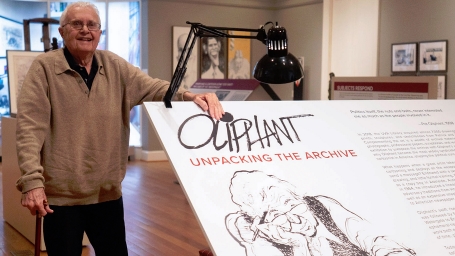
Oliphant lost his eyesight around 2015 due to glaucoma and macular degeneration and retired from professional newspaper work, ending a career that ran from 1965 to 2015 — but he always continued to draw.
“His body of work is going to be analyzed and studied by scholars for a long time. He’s in the pantheon,” [historian and author] Sides said. “There’s maybe only five other political cartoonists that rival him.”
UPDATE
The New York Times obituary by Robert D. McFadden (or here).
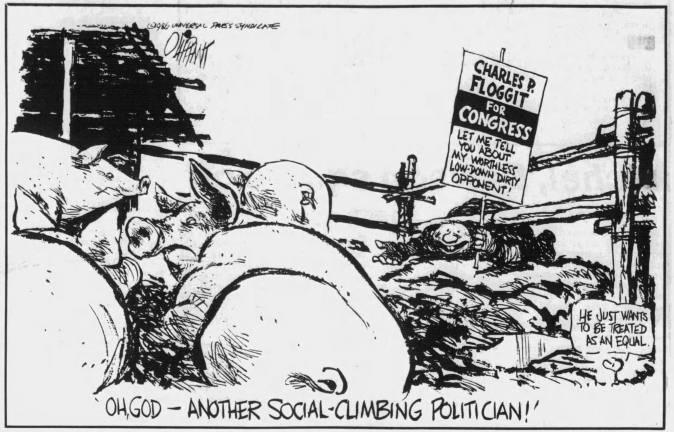
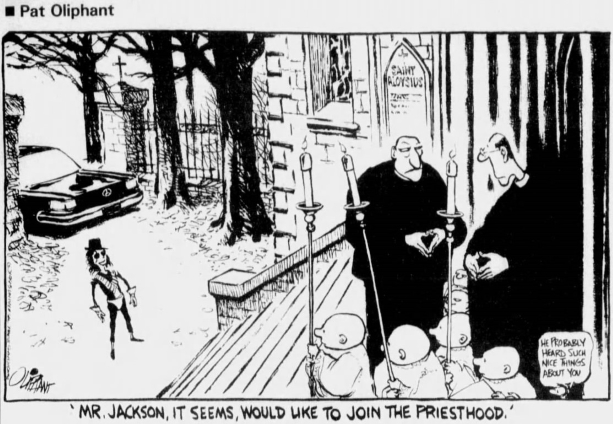
A largely self-taught artist who also created bronze sculptures and painted in oils, Mr. Oliphant skewered powerful public officials and religious institutions with such boldness and acid wit that a Washington Post critic once said, “If Pat Oliphant couldn’t draw, he’d be an assassin.” In 1990, a profile in The New York Times Magazine called him “the most influential editorial cartoonist now working.”
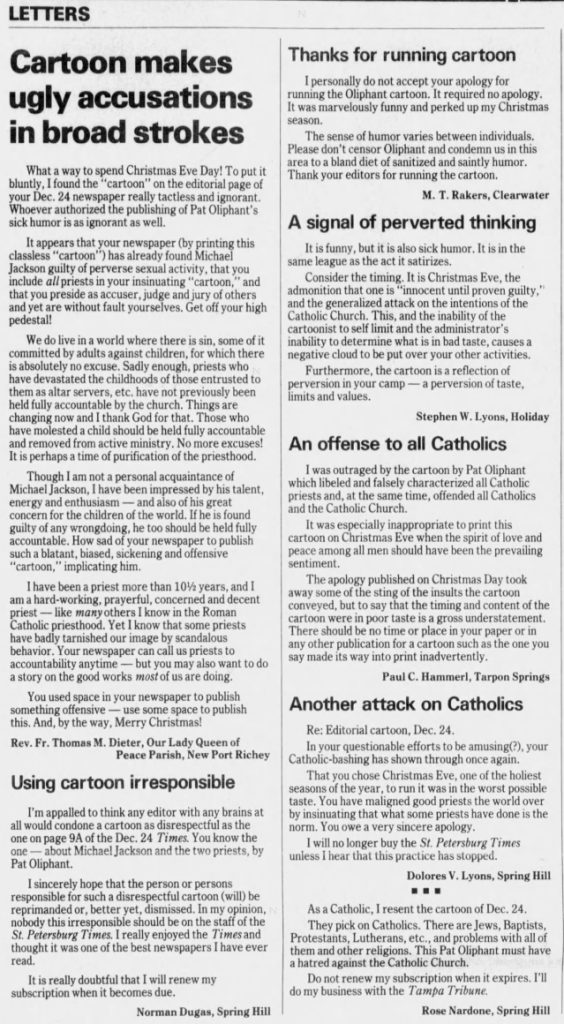
His irreverence and his blunt, spare style, sometimes likened to that of Honoré Daumier, the 19th-century French caricaturist, was often imitated by other cartoonists. But he was also vilified by religious and civil rights groups for cartoons that his critics said not only crossed the lines of good taste but unfairly damaged the reputations of people and institutions — and that, at their worst, were racist.
Before Mr. Oliphant established himself as the nation’s most dominant political cartoonist…
The Washington Post obituary by Alec Dent (or here).
At 18, Mr. Oliphant landed a job as a copy boy at the News, an Adelaide newspaper owned by Rupert Murdoch’s father, Keith Murdoch. He had aspired to work as a reporter, but in 1955 he left the News for its rival, the Advertiser, and began doing minor illustration work, drawing maps and retouching photos. Soon, he said, “drawing won out,” and he left writing behind to be the Advertiser’s editorial cartoonist.
When editors disagreed with some of his cartoons, Mr. Oliphant began adding a tiny character at the margins, Punk the penguin, to voice his forbidden political views.
Inspired by a real-life penguin that had washed ashore in Adelaide, the character remained a staple of his cartoons for decades…
July 15 UPDATES
From Pat’s country of birth comes Antimo Iannella for Cairns Post (or here).
The Adelaide Hills boy who became one of the world’s most influential political cartoonist has died, leaving behind a legacy spanning more than 400 newspapers.
Raised in Aldgate, in the Adelaide Hills, Oliphant started his career as a copy boy at afternoon paper, The News, in 1952. Three years later, he transferred to The Advertiser, where he was appointed daily cartoonist before moving to the US to take up a position at The Denver Post in 1964.
Speaking of The Denver Post: Here is their obituary (or here) for the cartoonist that got The Denver Post their second Pulitzer Prize (the first Denver Post Pulitzer came three years earlier because of the talents of editorial cartoonist Paul Conrad).
Pat Oliphant dies: Former Denver Post Pulitzer-winning political cartoonist was 90
Oliphant joined The Denver Post in 1964 and won a Pulitzer Prize for editorial cartooning in 1967, which he despised
That’s right the Digital First Media/Alden Global Capital newspaper couldn’t be bothered writing an obituary for one of their own and so used the Associated Press obit with their contribution being the headline and subhed above. Update: see below.
Here is that Associated Press obituary by Wufei Yu.
A multidimensional artist who also created sculptures, lithographs and oil paintings, Oliphant was widely considered the most syndicated editorial cartoonist in the U.S. During the 1980s, his daily political cartoons appeared in more than 500 publications in the country and around the world.
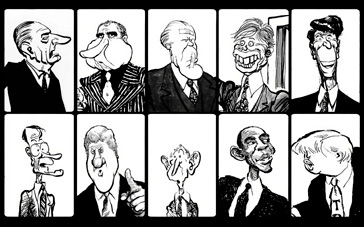
For over five decades, Oliphant’s work ridiculed powerful figures — from President Lyndon B. Johnson to Donald Trump — with a blunt and meticulous stroke. He drew Jimmy Carter with large teeth and lips, alluding to his background as a farmer and the cultural stereotype of adaptation to rural work, and depicted Ronald Reagan, whom he thought was uninterested in the suffering of the American people, with a cork in his ear.
July 20, 2026 Update
Editorial Cartoonist Mike Keefe, who took The Denver Post position when Pat left for Washington D.C. has authored a remembrance for the paper published on July 20th (or here).
He spent 11 years on the [Denver Post] editorial page and was an innovator bringing a new approach to the art form. In the 50s and 60s, most American cartoonists drew in a square or vertical format and preferred a heavy-handed approach—self-serious commentary. Oliphant opted for a horizontal display, much like a movie screen. This allowed him to create action scenes, movement from left to right. And he used humor to get his point across.
His was a devastating wit.

Comments 12
Comments are closed.